Roche Receives FDA Clearance for Elecsys pTau217 Blood Test to Advance Alzheimer’s Diagnosis
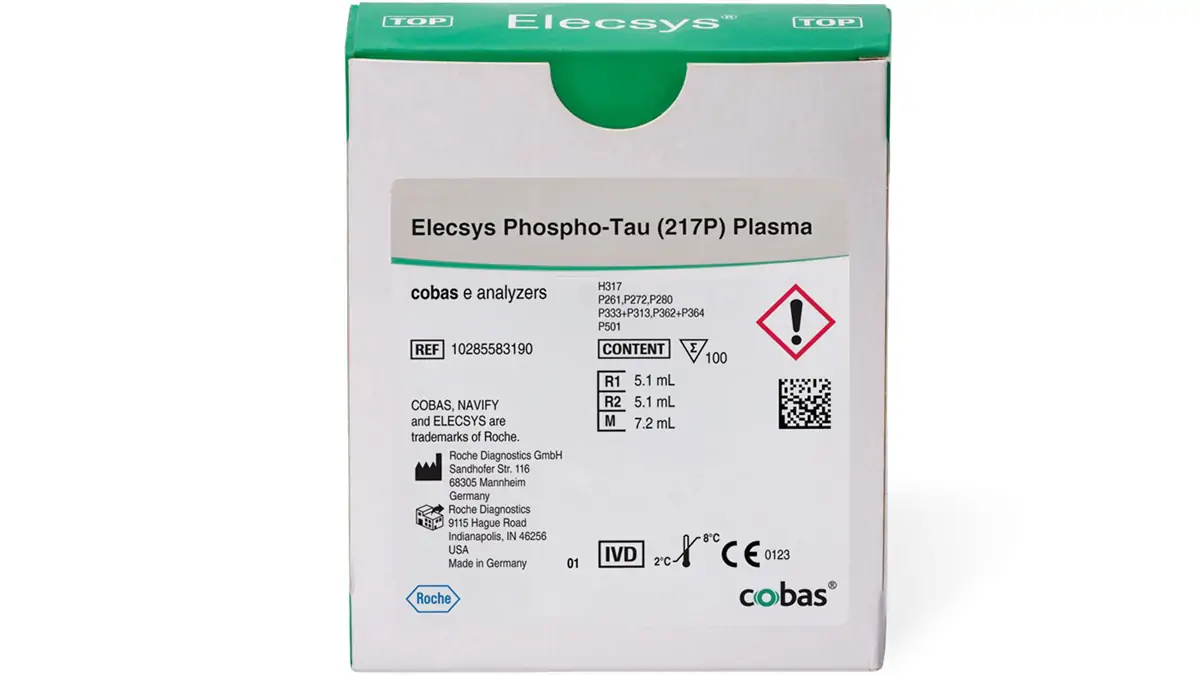
Roche has received the U.S. Food and Drug Administration (FDA) clearance for the Elecsys Phospho-Tau (217P) Plasma blood test, providing clinicians across primary and specialty care with a blood-based option to aid in identifying amyloid pathology associated with Alzheimer’s disease in individuals 55 years and older with signs, symptoms, or complaints of cognitive decline. Developed in collaboration with Eli Lilly and Company, Elecsys pTau217 is the first and only FDA-cleared, single-biomarker blood test that supports both rule-in and rule-out assessment of amyloid pathology using the same validated clinical cutoffs across primary and specialty care settings.
The assay provides positive, intermediate, and negative result categories to support assessment of the likelihood of amyloid pathology. Results are interpreted in conjunction with clinical information and other relevant findings as part of the Alzheimer’s disease diagnostic pathway. The test is designed for use across Roche’s more than 4,500 cobas laboratory instruments in the United States, enabling broad access through existing laboratory infrastructure.
Dan Malarek, President and CEO of Roche Diagnostics North America, said the FDA clearance marks an important milestone in Alzheimer’s disease diagnosis and underscores Roche’s continued leadership in advancing innovative solutions that can help patients get answers sooner. Malarek noted that as the first and only FDA-cleared, single-biomarker blood test supporting both rule-in and rule-out assessment of amyloid pathology, Elecsys pTau217 has the potential to transform how Alzheimer’s is assessed across primary and specialty care, helping bring diagnostic evaluation closer to patients and giving clinicians greater confidence in determining the right step in their care.
Carole Ho, M.D., Executive Vice President and President of Lilly Neuroscience, said for millions of families navigating the uncertainty of Alzheimer’s disease, a timely diagnosis is the first and most critical step toward meaningful care. Ho noted that Lilly’s collaboration with Roche on Elecsys pTau217 was driven by a shared commitment to bringing one blood test into both primary care, where most patients with cognitive complaints are first seen, and specialty care, helping close the gap between symptoms and answers.
Following the FDA clearance, Quest Diagnostics announced it will introduce an AD-Detect-branded laboratory test service based on the Roche assay to physicians and clinical trials collaborators nationwide in the fourth quarter of 2026, with plans to incorporate the test into future AD-Detect panels in 2027. Michael K. Racke, MD, a board-certified neurologist and senior medical director of neurology at Quest Diagnostics, said blood-based biomarker testing has rapidly set a new standard of care for guiding treatment and diagnosis decisions for Alzheimer’s disease. Racke noted that Quest is constantly looking to add innovations to its AD-Detect portfolio so that physicians and patients can make the most informed care decisions, and that the company looks forward to adding the Elecsys pTau217 test to give physicians across the U.S. ready access to this important biomarker.
Labcorp also announced it will offer the Elecsys pTau-217 test following the FDA clearance. Dr. Brian Caveney, chief medical and scientific officer at Labcorp, said the best advances in Alzheimer’s disease testing should make the diagnostic process simpler, more accessible, and more consistent for both patients and clinicians. Caveney noted that for individuals and families seeking answers about cognitive changes, the evaluation path can be long and uncertain, and by making the test available nationwide, Labcorp is expanding access to innovative blood-based testing and helping clinicians provide more timely assessments and informed next steps for patients.
The Elecsys pTau217 test is evaluated in individuals 55 years and older with signs, symptoms, or complaints of cognitive decline associated with Alzheimer’s disease and demonstrated high agreement with amyloid PET imaging. As a single-assay solution, the test simplifies laboratory implementation by using one biomarker and one set of validated clinical cutoffs to support both rule-in and rule-out assessment of amyloid pathology. Roche refers to this approach as the “Power of One” — one assay, one biomarker, and one set of validated clinical cutoffs designed to simplify Alzheimer’s assessment while expanding access to blood-based testing. The test is not intended to be used as a stand-alone diagnostic tool. Results should be interpreted in conjunction with other diagnostic tools and clinical information. The clearance builds on more than two decades of Roche innovation in Alzheimer’s disease, and the company’s portfolio also includes other diagnostic assays and investigational medicines including trontinemab and nivegacetor.